
Interview with Emma Webster and Friedrich Petzel
Friedrich, when did you first encounter Emma Webster’s work, and what initially stood out to you?
Friedrich Petzel: If I remember correctly, our colleague Jeremy [Wingfield] introduced me to Emma’s work at Art Basel Paris. He said, “Come with me,” and showed me a very large canvas at the booth. I was immediately struck by the orchestration of light—it felt eerie, especially within the context of landscape painting. I hadn’t seen a contemporary artist working at that scale in quite some time. That was probably four or five years ago. Can that be?
Emma Webster: Around then, yeah, that makes sense. I think I know exactly which painting you mean from Paris.
FP: That was a killer painting.
EW: Yeah. I think there’s been a long behind-the-scenes [process] … the fact that you’ve seen me through multiple studios and really not just seeing the work evolve, but seeing the career and the trajectory evolve, too.
FP: During our first studio visit, Emma and I talked a bit about the genre of landscape paintings. And that genre, to some extent, was excluded from the modernist canon. Few 20th-century modern painters truly engaged with landscape, which intrigued me. At the time, I was considering doing an exhibition with a colleague from Rome that looked at Baroque painting juxtaposed with contemporary artists engaging with certain traits or genres from the past, but with a contemporary bent, not being nostalgic about it.
I remember looking at Emma’s work and thinking it couldn’t have been made in the 20th century for many reasons. It looked different in how the light fell behind the trees or vegetation. The perspective felt unfamiliar, unlike what I would expect from a Claude Lorrain painting or from any of those more classical 17th-century painters.
So, we started talking about an exhibition that included Jeff Koons, Cindy Sherman, and other contemporary artists at my uptown gallery, and Emma contributed one painting to that. And that really got us closer to the idea of her showing at Petzel.
Emma, how did your relationship with Petzel begin, and what drew you to the gallery?
EW: Well, it's… it's fun. I got to know Petzel the Gallery before I got to know Friedrich, and Petzel the Gallery I've been following for many, many years. You guys have fostered some of my favorite painters–Nicola Tyson and Dana Schutz–I put you guys on this pedestal.
I started coming into Petzel Gallery when I was doing my MFA at Yale. I would take the train in at least once a month, if not every other weekend, just to see the shows at Petzel. And you guys stood out as this gallery that had this real rock and roll edge. There's this sense that you are willing to show challenging work, you were willing to show work that was head-scratching. It wasn't just about pleasing the public, it wasn't about beauty, and I felt that once I finally got to meet you, Friedrich, and speak to you in these studio visits, I was just astounded at how intelligent and thoughtful you are, and it doesn't surprise me that you've been able to foster such names and such talent. It's just been this wonderful unfolding between seeing the gallery as a grad student and kind of imagining it to now actually knowing it on the inside and getting to have this wonderful first big, big show.
Emma, what did representation mean to you at the moment you decided to join Petzel?
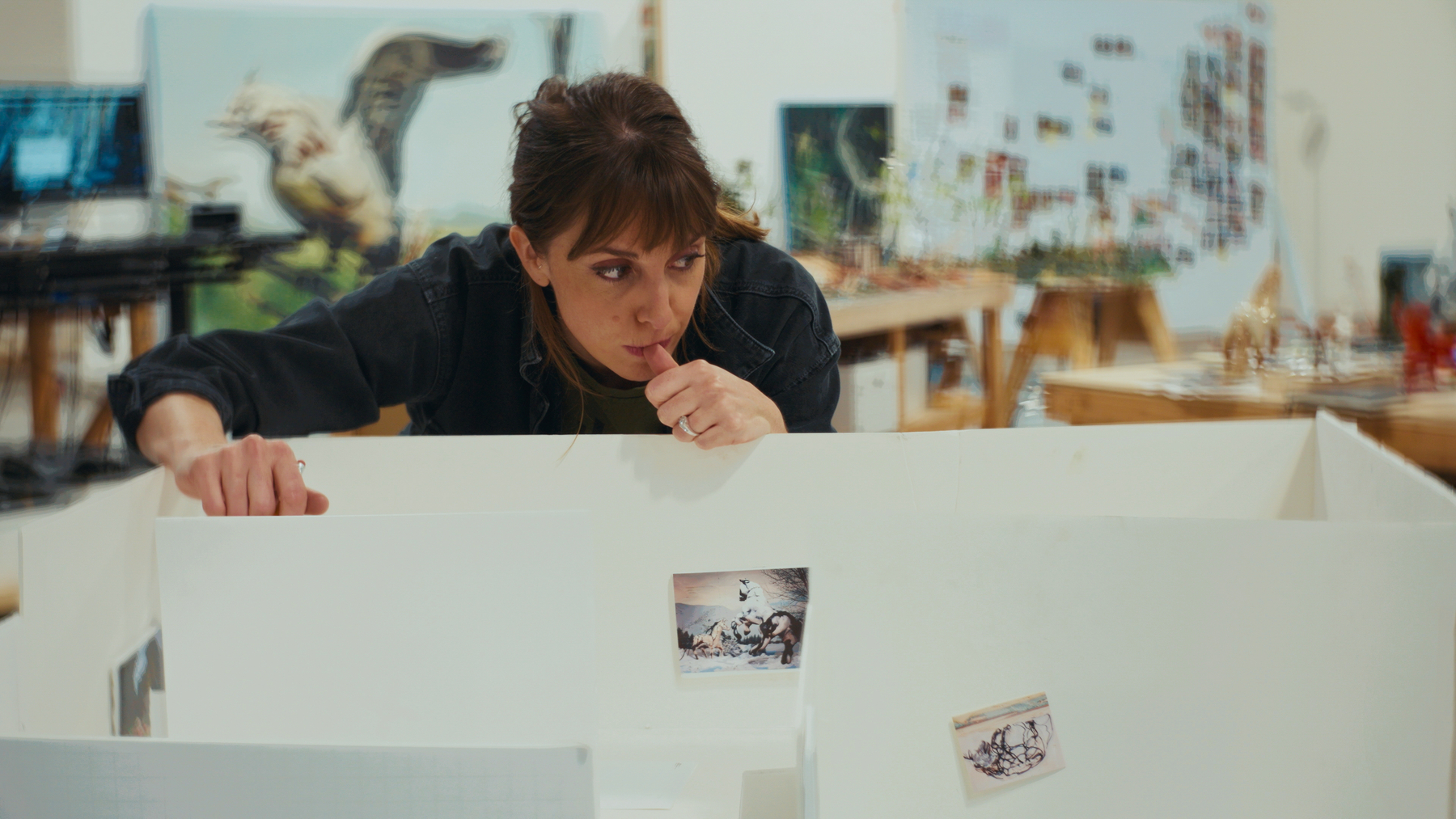
EW: I've been building these dioramas, these maquettes, these little worlds. But there's a whole world past that. Petzel offers this wonderful new lens to show and contextualize the work to a new audience, not just to New York, but the world. Because what I'm doing is a totally new genre of painting. I'm doing still life from digital source material, which there are very few other artists doing this, and so it requires a knowledgeable, intelligent voice to contextualize that and make it make sense in art history.
Friedrich, what qualities in Emma's work align with the broader vision of Petzel and its history?
FP: Emma said it better than I could. I try to challenge myself with new ways of looking at art. I'm not particularly nostalgic in terms of art, even though I'm deeply immersed in the Old Master’s painting tradition.
I think Emma's paintings have allowed me to reconsider certain kinds of possibilities in genre painting or landscape paintings that I didn't see being possible. And that aligns with the artists we represent—they always make us think or look again.
When I learned that Emma’s work incorporates digital and virtual technologies, it deepened my interest. I’m fascinated by how a young artist can engage art history through contemporary tools, offering viewers a new experience of how the world appears. The world looks different today than it did 100 or 200 years ago. And that resonated with me.
Emma, your work navigates tensions between natural landscape and digitally constructed space. Can you talk about how your process begins?
EW: Since the dawn of time, we have been manipulating space and the landscape around us. We've been carving it to suit our whims. By bringing that into the studio, by approaching landscape, or by approaching the diorama as a proxy to landscape. I think it really highlights the ways that we warp nature in order to suit whatever we would like.
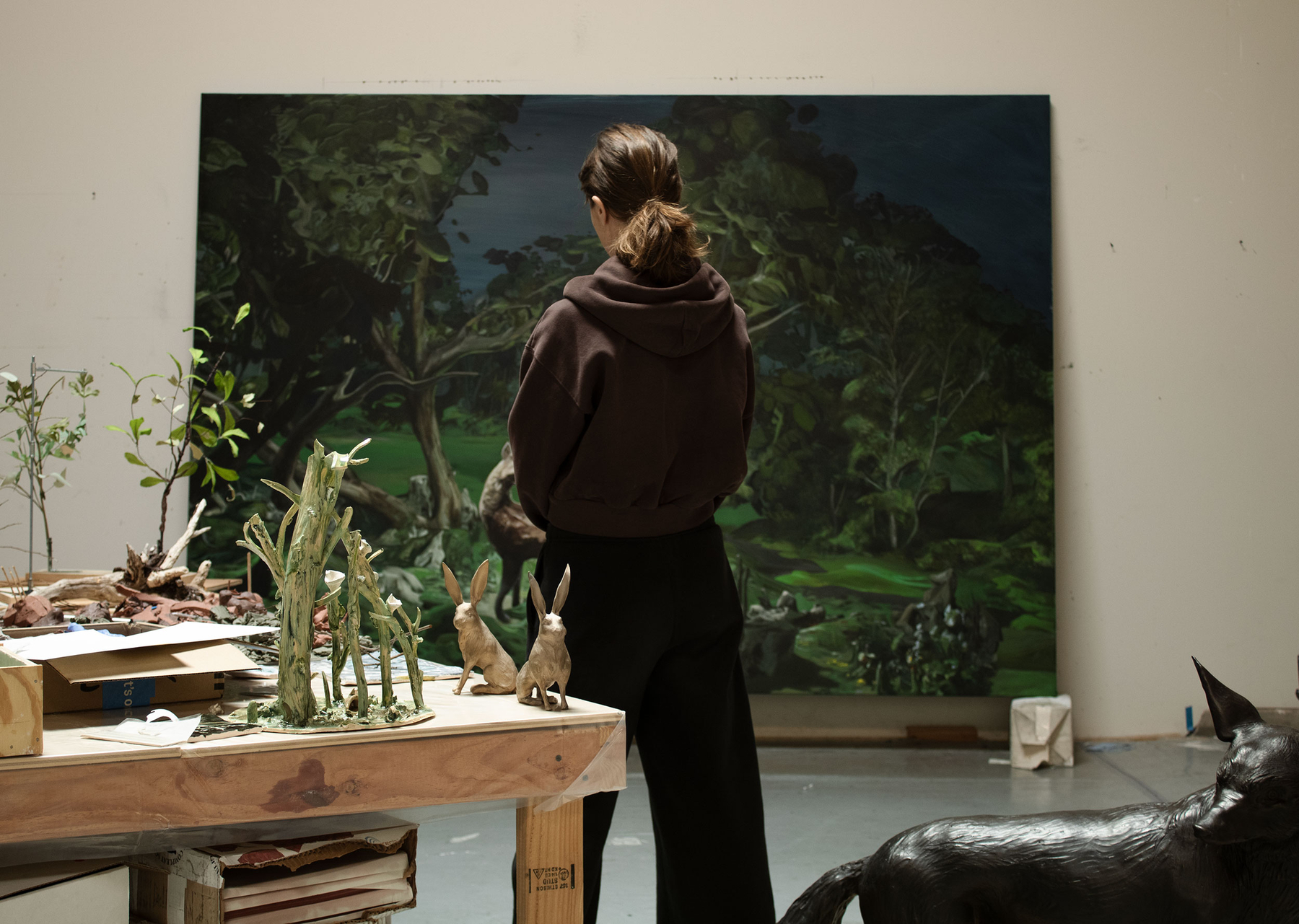
It would have been impossible in the past to build a landscape and then paint from it. Physically, that just would have been an impossibility. You couldn't make as many trees, you couldn't plant as many trees and then curate them in a certain way. There is this whole new frontier that has been cracked open by being able to create avatars for the natural world within these digital dioramas.
Can you talk a little bit more specifically about this technology and the simulation of this virtual space and how it factors into your painting practice?
EW: I think painting is defined by the representation of space. Even in a psychological or an abstract work, it is the ability to hold together the internal elements to show them in relation to one another. And so that's what I mean when I'm investigating space, I'm looking at: Is it stacked? Is it weighted? How is it anchored? How are things arranged? And landscape painting, I think we forget, is originally just about representing the space around us. It has been co-opted as being about nature or about the objects within the scene. But to me, it is originally about the observation of the natural phenomena around us, about the physical phenomena. And so that's what I'm trying to bring to landscape painting. I'm trying to maybe remove the trees, but really highlight this underlying system, this matrix, which is the space. It's the atmospheric pressure, it’s light, it’s scale shift, it’s things like this that make landscape reasonable or feasible.
FP: And it's a reflection. You said it in your words, it's like a reflection of us, how we construct that space in a painting, which is in and of itself a technological device of how to make sense of the world. Through the digital means you employ, the work reflects contemporary consciousness. It’s less about nature in that respect and more about how we think about nature. And we talked a lot about the three different, or more than three, different ways of thinking of nature: from an immersive perspective, from an almost spiritual Spinoza aspect, where God is hiding in each and every leaf. So we humans, we construct nature already.
EW: And it's funny, because we can see it so easily when we have, dollhouses, or we just look at miniatures of things that we've made. But we feel we have full dominion or domain over everything, even the things that we did not make.
Emma, what are some questions, apart from the ones that you just addressed, that you're trying to work through in your paintings right now?
EW: I think we look past landscape. We think there's something generic or banal about landscape. And so, what I'm questioning right now, or what I'm interested in for our upcoming show is I'm looking at a lot of simple, ubiquitous herd animals, and farm landscapes and these things that are sort of American and at the same time we don't think about a lot, or we don't think are interesting. In this attention economy, where we put our focus, things we think are valuable enough for our attention is a large indicator of respect and inquiry. That's one of the things that I'm thinking about specifically for this show, but generally speaking at large, a big question that I'm working through is how do I present the world, not just in the paintings, but in the digital and the sculptural. So, our upcoming show will be the first time where I show the digital dioramas in this video game, alongside the paintings. And I'm really excited to have viewers see these static scenes in the paintings, and then get to move through them, and have a much more immersive experience through the digital element.
Emma, how do you begin as an artist to even approach something of this magnitude, and say, “I'm going to change it in this way.”?
EW: That's a good question. I mean, to go in and say, “I'm gonna change it, I'm gonna be the first,” I don't know… that's a big ask. But landscape painting, to me, is always coded with a kind of escapism or a nostalgia. Landscape painting, when it became really big, happened right at the height of the Industrial Revolution as a response to get away from technology and get away from cities. And I think that yearning for the somewhere green, for the utopia, it's a very resonant call, and it's something that we're dealing with right now, when I think that the world is scary or disappointing, frightening, or violent. Landscape painting still kind of holds that idea of, “What if we could get away? Where would we be? Would we be happy?” And that call is something that I don't think will ever go away.
FP: Each generation’s paintings reflect its attempt to cultivate the environment. Representation, whether through painting or other media, reveals how we shape and interpret our surroundings.
Your work embodies that cultivation with a 21st-century inflection. These paintings would not have been possible 50 years ago. But they are new paintings, paintings that actually allow us to know something about ourselves with all the historical weight of what goes into our quest for maybe innocence, or a non-cultivated existence, or a non-cultural existence.
They are fantastic in the truest sense but also quite eerie and misleading. What interests me most is their capacity to intrigue, to make us subtly uncomfortable – that’s good!
EW: Yeah, I think there's this base yearning that heightens the sense that we are away from the thing that we want, or that something isn't as we expected it. But at the same time, the trees and the landscape… you're right, they don't feel as if they're from any other part of the past. There's something very hybrid, almost sci-fi. It's almost as if the content is somehow in the present or the future, but this base wants to be somewhere else, to get somewhere else, to go to this perfect place. It's timeless. It’s deep within us.
Friedrich, what do you think Emma brings to the gallery at this particular moment, both artistically and generationally?
FP: Artistically, I think there is no one like Emma. We always try to build the gallery around each artist’s voice. It should never compete with several others working in the same mode. Each artist should have his or her voice that is very unique, very individual. And hopefully also quite radical in its formation.
Generation-wise, we are now looking more towards artists that are in their 30s or 40s. Petzel is not a young gallery, I've been doing this for a long time with my staff here, but this is a new approach, and it's rooted in a deep understanding of historical precedence.
And I'm certainly interested in contemporary art using contemporary technologies. This is Emma's expertise right now, but obviously other artists in the program do this with other objectives.
Emma, how has being represented by Petzel influenced the way you think about scale, ambition, or even risk in your work?
EW: I've been obsessed with this idea of immersion, and how do I make people feel as if they're in these spaces visually, but immersion extends to an emotional sphere outside of it. How do we feel like we know all facets of a practice, of a person. It's a whole thing that I'm not in charge of, or I can't be the only voice for, so I'm so grateful for Petzel to bring all of these dimensions behind the trees to the viewers to tell all of the stories that I haven't thought of, or that I am not focused on because I'm just focused on the paintings.
Friedrich, what excites you most about the long-term trajectory of Emma's practice?
FP: I don’t have a crystal ball, but I see this as the beginning of a long relationship. One that will lead to a meaningful institutional presence for Emma’s work. Galleries function as a platform toward something larger: public commissions, sculptural projects, expanded forms of presentation. My hope is that each exhibition extends beyond the commercial framework of a gallery and enters a broader cultural dialogue. A strong show in Chelsea should ideally lead to institutional engagement like museum exhibitions, critical discourse. It takes time, concentration, and patience to reach the point where both artist and gallerist feel something meaningful has been realized.
EW: It's built on this “yes and,” that [belief that] each kind of venture leads to one other thing, that the practice gets to grow. Good painting is created by the ability to do things beyond the paintings, by the ability to find different ventures, to do different experiments, and it's wonderful to work with a partner, to work with Petzel, and to be able to contextualize, historicize, and educate along the way so that I can take these new experiments in different directions.
Emma, how do you hope viewers engage with your work?
EW: I think that my paintings are bizarre because they're still lives. Viewers engage with the works because they’re sculptures, in a sense, that are built all around them. The paintings are these worlds that change shape, change scale to fit the viewer, and so I hope that viewers engaged with the work by feeling a bit puzzled, by being confused in the sense that there's a convincing world around them, but they have to uncover the various narratives or actions within the works.
I want, I think above all, for viewers to engage with a new type of convincing observational painting–observational painting that isn't quite what they expected, that's not fruits on a table, but instead is all around them. And that really makes them question how this observational world that's around them is different from the world that they experience outside the gallery.
Looking ahead, what feels the most open or unresolved in your practice that you're excited to explore?
EW: I'm excited in this partnership to begin to reframe my practice from being one that is solely fixated on nature to one that is looking at still life as a methodology. That instead, it's really about how we take something, make it estranged from ourselves, view it, look at it from all of these different angles, because that's the underlying part of my practice that I think has yet to be fully fleshed out, explored, or explained to the public. It is that all of this comes from this still life premise. That by creating a proxy for a thing, we get to investigate the subject even further.
And Friedrich, what does representation mean to you today, and how does Emma’s work embody that relationship?
FP: Today, representation signifies commitment to an artist’s goals and to finding the right platform to pursue them. This is not a one-night stand. It requires time, trust, and mutual respect. Whether you begin working with an artist today or began 30 years ago, that trust ultimately allows the artist’s voice to resonate clearly within the present. Representation, to me, means serving a particular phase of an artist’s practice while supporting movement beyond the gallery’s four walls.
EW: It’s trust! Your point is so well taken! I mean, I feel it all the time… you're asked to sort of explain yourself before you know what you're doing, and what I love about this relationship or working with a gallery is it feels like it's the two of us going into the unknown, and you figure it out as the work is developing. It's no longer just the artist trying to understand and make at the same time. You have this partnership where you get to unveil the thing together. Neither one of us know what the thing is; we both are at that forefront, when it gets made, of both understanding it and explaining it.
Emma, as an artist, when you seek representation from a gallery or multiple galleries, what is the most important aspect for you?
EW: You don't just want a friend, but you want someone who sees the unknown future with you. You want someone who has the trust in your vision, who will help you both understand it and guide it. It's not just about selling the artwork or explaining the artwork to the public, though those are important. A good gallerist can also inform the artist as the art is being made. A good gallerist makes the art better–not just in the post, but also in the present. And that's why this is so important, is you have to pick the voice that you think is intelligent and savvy.
And I know that in this relationship, Petzel's voice is a voice that I value. I want to know what he thinks about my paintings as they're being made. I want to know the conversation that he brings to it before I share.
It has so much to do with how much you trust and respect the other voice here, and as someone who's watched the Petzel program for many, many years, they are the pillar, they are the ones I always look to, so I'm honored to be entering into this representation with you, Friedrich, and the whole team.