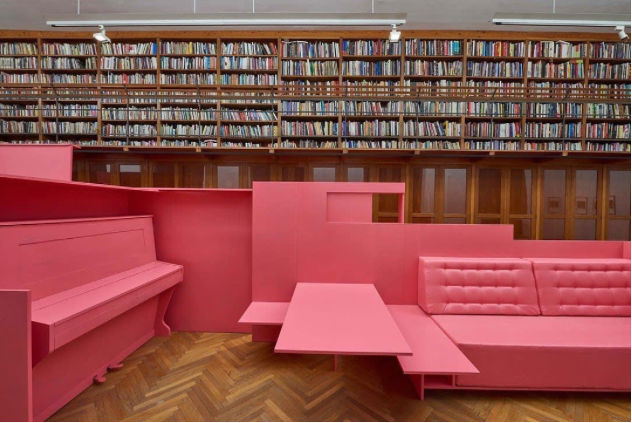
American artist Stephen Prina, who was born 1954 in Galesburg, Illinois and now lives in Los Angeles, adopts the approaches of Minimal and Concept Art in his works as these allow him to reflect on influential aspects of artistic and social developments over the past years and to address them in the context of the present. His projects, in the fields of painting and room installations, are characterized by a multi-layered reference system that takes up motives and topics from the fine arts, literature, film and philosophy which Prina combines in new contexts, reconstructing and varying their basic structures. The exhibition at the Staatliche Kunsthalle Baden-Baden is the first extensive retrospective exhibition of works by Stephen Prina in Europe. In addition to painting and photography the show will include room installations which take the peculiarities of the venue into account and enter into an exhilarating relationship with the architecture of the Kunsthalle.
In his works Prina refers to a wide range of important artists and theorists, including Theodor W. Adorno, Roland Barthes, Heinrich Böll, Marcel Broodthaers, Dan Flavin, Joseph Kosuth, Edouard Manet, Andy Warhol, and Lawrence Weiner. In addition to such references to particular motives and structures, Prina's works principally underscore the theme of art placed in exhibition spaces: his projects reflect on the context in which art emerges and form a special link between historical and current exhibition sites. The open, constantly developing structure of his works enables Prina to emphasise the provisional character and the genesis of art.
Prina is often involved in long-term projects which are adapted to their respective new context and exhibition space. The sound installation The Second Sentence of Everything I Read Is You pursues such an artistic strategy. It was first shown in 2006 at the Friedrich Petzel gallery in New York. In summer 2007 the artist created another version of that work, altering both the dimensions and the colour nuances. The installation conjures up associations with a temporary "travelling theatre spectacle": crates which once held the technical equipments are placed on the floor in the centre of the space and transformed into seats by means of cushions; cables and electronic sound elements are arranged visibly.
Lettering " ... Things Felix forgot to tell us ..." appears on the walls and this corresponds to the music composed specially by Prina for this installation. Music and text are taken from the book Felix Gonzalez-Torres, edited by Julie Ault (Göttingen, 2006), and reproduce various ideas about – and memories of – the Cuban-American artist Felix Gonzalez-Torres, who died in 1996. The highly suggestive sound of Prina's songs inspire the viewer to moved through the exhibition space and subjectively relate the various components – writing, sound and sculptural elements – anew. Prina's works, based on the de- and re-composition of the artistic material, are to be seen neither as a homage, nor as a critique. Instead they establish a lively and topical basis for exchange between artistic practices.
The use of sound elements and music in Prina's work is linked with a concern with the theme of time. On the one hand, this illustrates the process character of many of his works, and on the other, music itself is time-bound. In the installation The Top Thirteen Singles from Billboard's Hot Singles Chart For The Week Ending September 11, 1993 (1993) on the hour a clock plays one of the 13 hit singles from the American charts; the respective music has been rearranged as a peal of bells. As the conceptual process is the main focus, the choice of songs can involve melodies that are more or less suitable for such a transposition. The pieces range from the sound track of the Lion King to a rap version of the song Nothin' But a G Thang. When re-arranged, these pop songs turn out to be transient material, quickly forgotten once they have left the hit parade. Prina's work thus questions the Billboard Hitparade as an institutionalised yardstick for cultural-aesthetic quality.
For his exhibition at the Kunsthalle in Baden-Baden Prina will produce a new version of his sound installation The Second Sentence of Everything I Read Is You, so that the work will be transformed once again. Prina's working method, his questioning the social, historical and media context of art, is in harmony with the image of the Kunsthalle, which brings together contemporary minimalist and conceptual artistic positions. A two-language catalogue will be published on the occasion of the exhibition, providing a survey of Prina's work to date and documenting the works specially conceived for the Staatliche Kunsthalle Baden-Baden.
On Sunday, 27 July 2008 at 11:00 a performance by Stephen Prina will take place in the Orangerie of the Brenner's Park Hotel & Spa. A programme of events including lectures, film screenings and guided tours will complement the exhibition.